
How Nvidia lost $600 billion because of the Chinese new AI - Special Edition

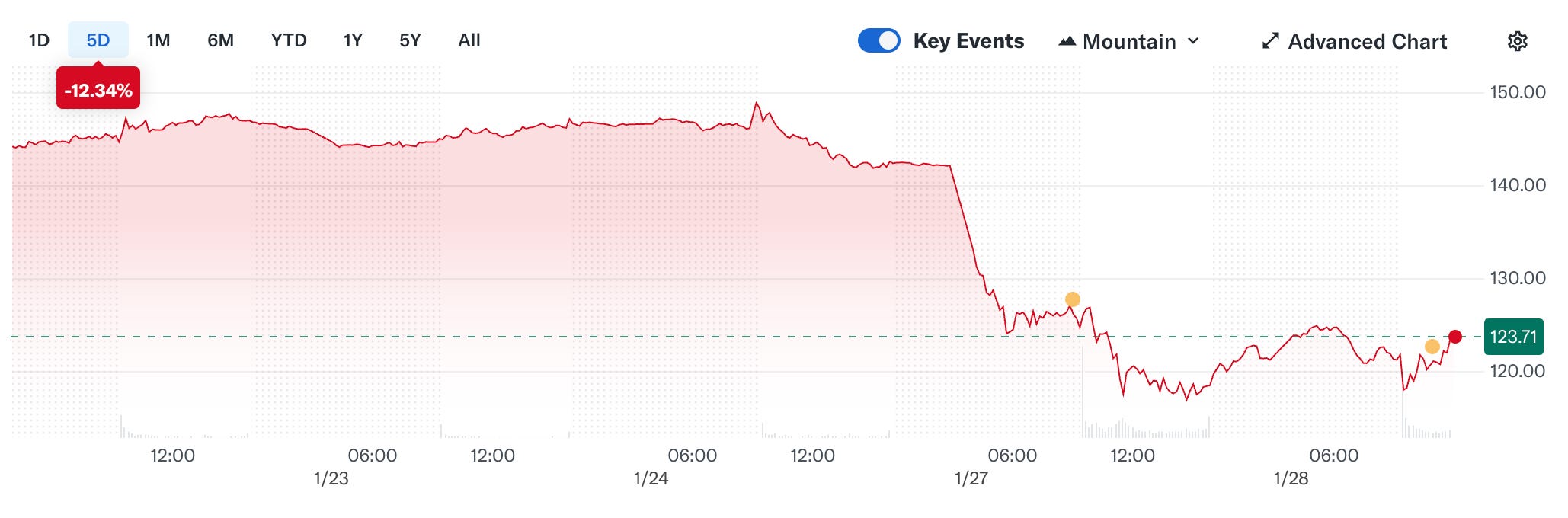
China’s DeepSeek has shaken up the AI industry with its powerful new model, R1. The launch hit Western tech giants hard, wiping over $600 billion from Nvidia’s market value and causing one of the biggest drops in years for the Nasdaq. Before Monday’s crash, it had been a strong week for Wall Street, with the S&P 500 up 1.74% for the week, boosted by Donald Trump’s initial announcements showing a more moderate stance on protectionism than expected.
In this edition, we’ll break down what happened, why it matters, and how it could change AI, tech investments, and global markets.
From a startup to a global disruptor
Founded in May 2023 by Liang Wenfeng, DeepSeek was launched with an ambitious mission: to democratize AI by creating advanced, open-source large language models (LLMs). While open-source AI models are not new, DeepSeek’s ability to innovate quickly and cost-effectively makes it different.
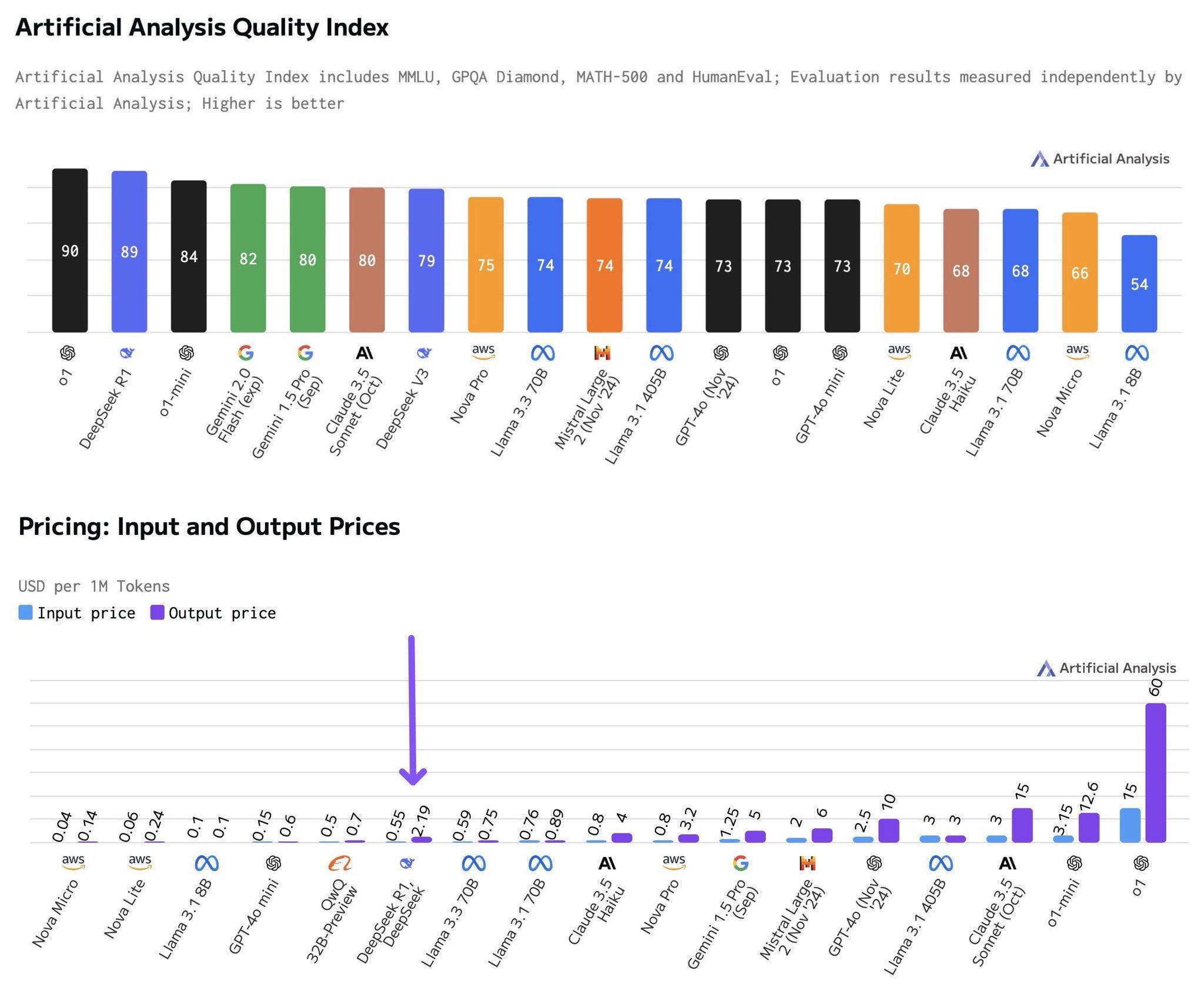
Key differentiators: The R1 model, released in early 2025, was developed in just two months with under $6 million in funding. By comparison, OpenAI’s GPT-4 required tens of millions of dollars and far longer development cycles.
Performance metrics: R1 rivals industry giants like OpenAI’s GPT-4 and Google’s Gemini in tasks like programming, mathematics, and natural language processing. Early adopters have already found it better in certain areas, particularly its adaptability to resource-constrained environments.
How DeepSeek triggered Nvidia’s market crash
Nvidia has long been synonymous with the exponential growth of AI. Its GPUs power the largest data centers and training infrastructure for generative AI models. Yet, the success of DeepSeek’s R1 has questioned Nvidia’s dominance.
Why did Nvidia’s stock drop?
DeepSeek demonstrated that powerful AI can be trained and deployed without the exorbitant hardware costs traditionally associated with AI training. This efficiency undermines Nvidia’s core value proposition: its high-end GPUs.
Investors fear that R1’s success could reduce the industry's reliance on Nvidia chips as companies explore ways to build AI systems using more cost-efficient alternatives.
Nvidia’s stock lost nearly 17% of its value in a single day because of the market sentiment spiral or "market panic”, wiping out over $600 billion in market capitalization. This marked the largest one-day loss in Nvidia’s history.
What about broader economic indicators?
Bond markets: The 10-year Treasury yield briefly declined, signaling a flight to safety.
Currency strength: The USD weakened slightly as concerns about the tech sector’s stability spread.
Domino effect across the tech sector
The fallout didn’t stop with Nvidia. The entire tech sector, particularly AI and semiconductor stocks, felt the impact:
The Nasdaq fell by 3.1%, dragging down major tech players. Alphabet (Google’s parent company) and Microsoft saw combined losses of nearly $170 billion in market value.
The Philadelphia Semiconductor Index experienced its biggest percentage drop since March 2020.
Asian markets, particularly in Taiwan and South Korea (key hubs for semiconductor manufacturing), also saw a pullback in response to DeepSeek’s potential.
How did DeepSeek make it work?
DeepSeek has reimagined AI model architecture. Instead of using an approach that requires thousands of $40,000 GPUs, the company developed optimization techniques. Its "multi-token" system, for example, processes entire sentences at once instead of word by word, cutting processing time in half. Even smarter, its "expert" architecture activates only the parts of the model needed for each specific task, reducing memory and computing power requirements.
What are Nvidia’s challenges?
Nvidia’s rise over the past two years has been pushed by the AI boom, with its GPUs dominating everything from AI training to inference tasks. However, the DeepSeek situation shows potential vulnerabilities in Nvidia’s business. Nvidia’s current profitability depends heavily on demand for premium GPUs like the H100. If companies can achieve similar results with more efficient alternatives, this demand may come to a halt. Also, with the U.S. imposing export restrictions on AI chips to China, DeepSeek’s success could encourage other Chinese firms to get independence from Nvidia’s hardware, further reducing its addressable market. Nvidia relies on big data centers and AI companies as its main customers. If these players start switching to cheaper alternatives, Nvidia could take a major hit.
Now that we covered almost everything, what is the real kicker?
The secret recipe of DeepSeek is openly shared in a detailed paper. It is surprising, especially in a world where companies are competing for dominance. Why hand over competitors the tools to copy your work? Yet, according to the CEO, this was intentional. He recently laid out their reasoning:
China wants to actively contribute to innovation and push technological boundaries, not just chase quick profits.
They’re tired of riding on the coattails of others’ advancements. For 30 years, they’ve been lagging, merely observing from a distance.
They have money and don’t need to earn more.
The ban on high-performance GPUs annoyed them enough to think outside the box and come up with solutions others hadn’t considered.
Open-sourcing and publishing papers might not bring financial gain, but it builds respect, and they’re seeking that recognition.
In short, China is done being a follower. This shake-up will likely continue for months and years to come.
As Trump declared, DeepSeek’s rise and the resulting market turbulence are a wake-up call for the US tech industry. As the storm passes, it’s clear we are entering a new era.